
The dryer route from Park Circle to the peninsula
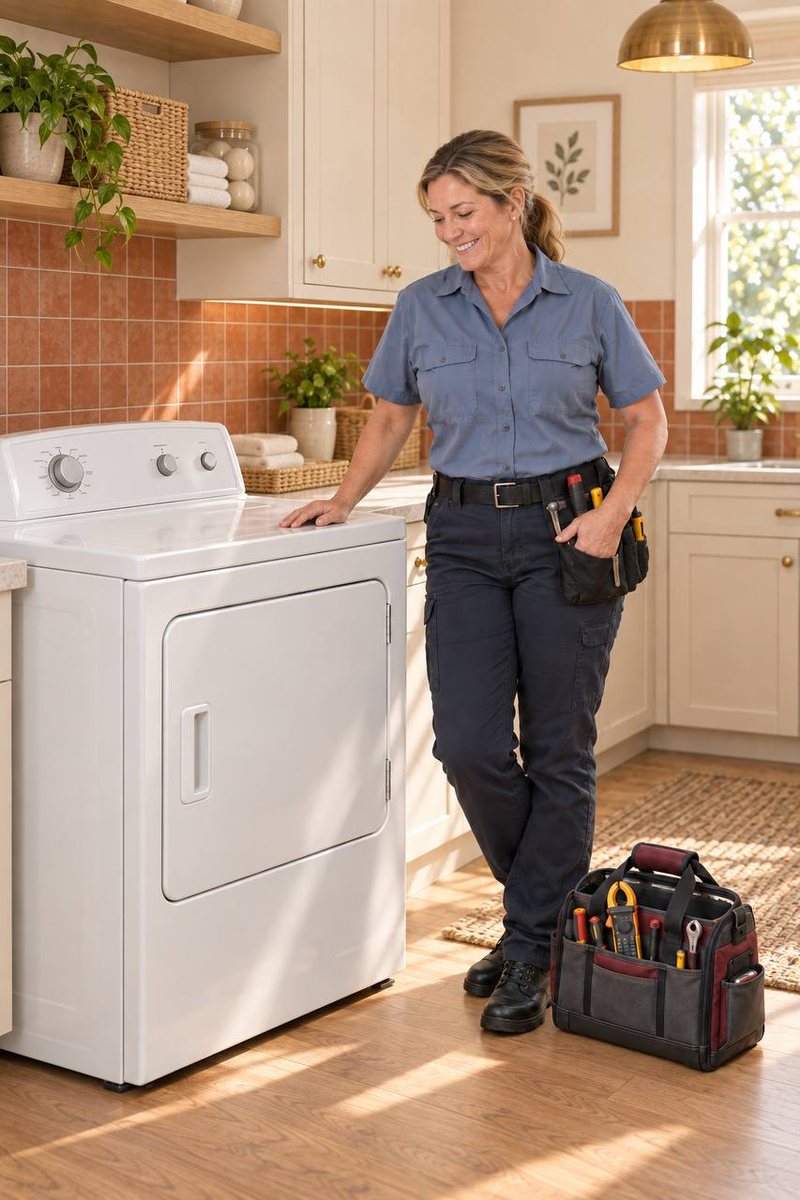
The run is simple on paper: O’Hear Avenue to Rivers, Rivers to I-26, and off at Meeting or Rutledge fifteen minutes later. The last half mile is the real work. Streets around the Citadel and Hampton Park were laid out for carriages, Wagener Terrace has cars on both curbs, and South of Broad the house may only be reachable through a side-yard gate and along the piazza. We plan the approach when you book, ask about the gate and the dog, and carry the tools in one pass. The dryer itself is usually in a closet, a former pantry or a bathroom alcove, often stacked, with a vent run that turns twice before it finds a wall.
Peninsula dryers fail from the vent backward. Harbor humidity turns lint into felt inside a flexible duct, airflow drops, the machine runs hot, and the thermal fuse opens. That is the no-heat call we hear most from Harleston Village and the streets off King. The second pattern is gas: a dryer that starts warm and goes cold after ten minutes has an igniter or a flame sensor giving up under load. Picture a stacked pair in a 1910 single house near MUSC where a two-hour cycle has become normal. The owner assumes age. It is a vent that has not passed air properly in three years, and a fuse that finally quit protecting it.
Dryer symptoms and what sits behind them
Tumbles, but the air stays cold
On electric dryers this is the heating element, the thermal fuse or the high-limit thermostat, and the meter separates them in a minute. On gas it is the igniter, the flame sensor or a coil on the gas valve. We check airflow at the same time, because a fuse that opened over a clogged vent will open again.
Cycles run twice as long as they used to
Restricted airflow almost every time. Felted lint in the duct, a crushed transition hose behind a stacked unit, or a roof or wall cap glued shut with lint and salt spray. We measure airflow at the exhaust, clear what we can reach, and tell you plainly if the vent run itself needs a different trade.
Warm for ten minutes, then cold
A gas dryer whose igniter glows but the flame sensor no longer proves it, or a gas valve coil that opens when cold and fails once it heats. Both are hard to catch on a short test, so we run the machine long enough to see the drop and read the coils while they are hot.
Squeal, thump or grinding from the drum
Drum rollers rusted by closet humidity, a glazed idler pulley, or a belt that has slipped and frayed. Front glides wear through on older Whirlpool and Kenmore units and let the drum ride metal on metal. We replace the wearing set as a group so you are not calling us back for the next roller.
Burnt smell or scorched clothes
Lint has reached the heater housing or the burner, or the cycling thermostat has failed and the element is running without a limit. This is the call we move up the route. We shut the machine down, clear the housing, test both thermostats and the fuse, and do not leave until the vent flows.
Starts, then stops after a few seconds
A door switch that has corroded open, a belt switch on an older model, or a motor whose centrifugal switch is sticking. Newer machines will throw a code first; photograph it before it clears. We test the switch chain in order and replace the one that reads open.
The procedure
- Exhaust airflow measured first, before any electrical part is condemned.
- Meter on the fuse, thermostats, element or igniter in sequence.
- A single written price; the $99 diagnostic is built into it.
- Fuses, elements, igniters, rollers and belts on the van for the common brands.
- Full heat cycle run, lint cleared, written warranty handed over.
Downtown Charleston dryer repair, step by step
We start with your description and the machine’s history, then take the back or front panel off and put the meter on the fuse first, because it is the most common failure. If it reads open, we do not stop there; we measure the vent, because the fuse is a symptom. From there it is the high-limit, the cycling thermostat, the element or the igniter, each read for resistance, and the motor if the drum is not turning. Stacked pairs come down onto a pad. Gas connections are leak-tested with solution before we leave. You receive the failed part in plain words and one written number, and nothing is replaced until you say yes.
Van stock covers Whirlpool, Maytag, Kenmore, GE, Samsung, LG, Frigidaire, Electrolux and Amana, plus the Bosch and Miele condensing and ventless units that fit peninsula closets with no exterior wall. For short-term rental owners near King Street and landlords with student tenants near the Citadel and MUSC, we coordinate the visit with the cleaner or tenant, send the quote to the owner by text, and email the invoice and written warranty. The rule on the bill does not change from block to block. The $99 diagnostic is already inside the repair price you approve. If you choose not to repair, $99 is the whole charge. An online booking takes up to $20 off the repair, never off the diagnostic.
Asked in Downtown Charleston
Why does my downtown Charleston dryer keep blowing the thermal fuse?
Because the vent is the underlying problem. Peninsula humidity packs lint into felt, the duct restricts, the dryer overheats and the fuse opens to protect it. A new fuse without a cleared vent lasts a few months. We measure airflow before replacing the fuse and tell you what the duct needs, whether we can clear it or it needs a vent contractor.
Can you repair a ventless or condensing dryer in a peninsula condo?
Yes. Bosch, Miele, LG and GE ventless models are common in Harleston Village condos and carriage houses where there is no exterior wall for a duct. They fail differently: clogged condensers, failed pumps and sensor faults instead of vent problems. We service them the same way, meter first, one written price, repair from the van when the part is on board.
How soon can you get to a dryer in Wagener Terrace or Hampton Park?
Within the week as a rule, and frequently the next day. Downtown Charleston is a fifteen-minute run from the shop, so we can fit a peninsula stop between Park Circle calls without waiting for a full day of downtown work. Tell us the parking situation and whether the machine is stacked so the technician arrives with the right gear.
Is gas dryer repair different downtown?
The machine is the same; the house is different. Older peninsula homes often have a flexible gas connector that has been kinked by years of pushing the dryer back, and shutoff valves that have not been turned in decades. We inspect both, leak-test with solution after any work, and will not reconnect a connector we do not trust.
Does a Downtown Charleston dryer visit cost more than one in North Charleston?
No. There is no downtown or parking surcharge. The $99 diagnostic is the same in 29401 and 29403 as it is on O’Hear Avenue, and it sits inside the repair price when you approve the work. Say no to the repair and $99 is the entire bill. Online bookings take up to $20 off the repair.